Untimely Christianity by Michael Edwards
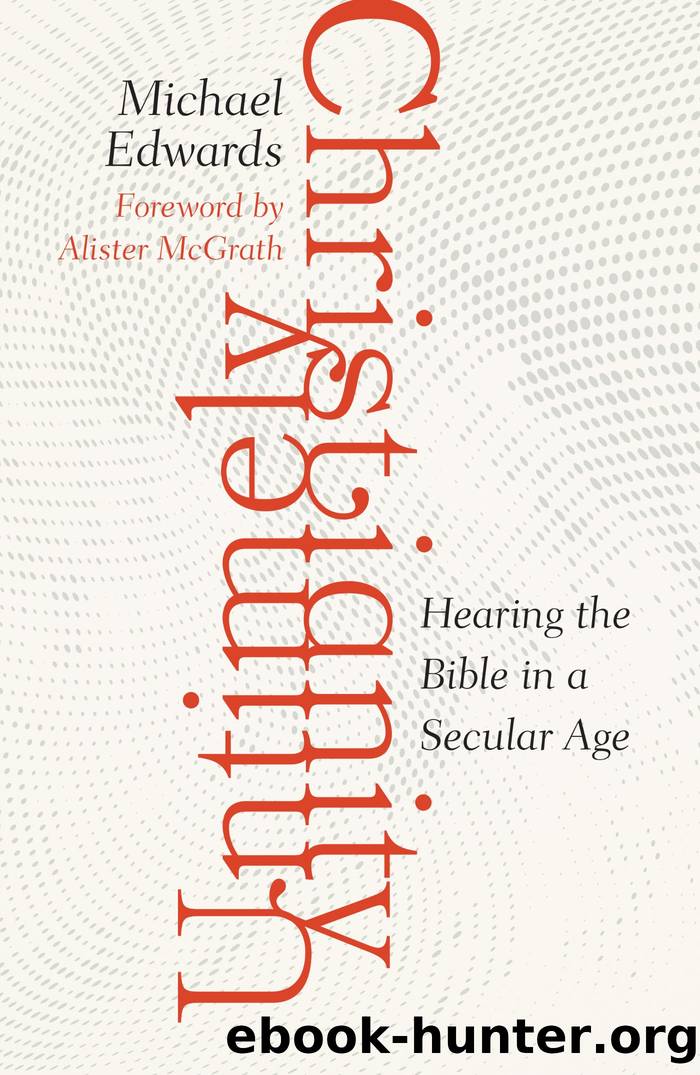
Author:Michael Edwards [Edwards, Michael]
Language: eng
Format: epub
Tags: REL067000 Religion / Christian Theology / General, REL006080 Religion / Biblical Criticism & Interpretation / General, POE003000 Poetry / Subjects & Themes / Inspirational & Religious
Publisher: Fortress Press
3.
If Christ incarnate knew, in our place and on our Earth, life, death, and resurrection, all Christians are invited to follow him in each one of these stages and to testify of this in the culture where they find themselves. Saint Paul goes so far as to write, âI live; yet not I, but Christ liveth in meâ (Galatians 2:20). These words, which suggest a radically other point of view on anthropology, no doubt surpass our intelligence by evoking an experience far above ours. At least we thus know what perfection to aim at. Paul writes this as well, on the subject of Christ as the supreme goal of our life: âThat I may know him, and the power of his resurrection, and the fellowship of his sufferings, being made conformable unto his death, if by any means I might attain unto the resurrection of the deadâ (Philippians 3:10â11). Life, death-and-suffering, resurrection-and-power: the Christian is led to know at the deepest level happiness, sorrow, and hopeâwhat could be more vital than the life of Christ, what more grievous than his death, more elating than his resurrection?âand can then demonstrate the manner in which this ternary vision is propagated in the culture and gives it form.
For in the most materialistic, the most secularized culture, the dynamic of dissatisfaction is at work. All the forms of art, far from constituting a simple entertainment, a pleasant supplement to the individualâs and societyâs serious efforts, are found at the heart of our reflections on the human condition. If one distances oneself from mockery, from exhibitionism, from enchantment with success or the marketâfrom all the temptations that naturally threaten enterprises that are, at their level, salutaryâthose forms give themselves to the search for a reality, a manner of being, beyond the polarity of happiness and sorrow. Dance transcends, during the performance, the vitality and mortality of the body and offers a glimpse of a free, creative, airborne body that recalls the Christian promise of a âgloriousâ and âspiritualâ body. Music, which exists both in the ear and nowhere, transfigures the human voice, transforms the noises of the world into sounds, and gives to timeâthe medium of all our happinesses, which, however, leads us toward deathâa new form, a tempo that makes of it a kind of temporary paradise. Painting, if it is somewhat figurative, renews our way of seeing, as well as a body, a tree, or several objects on a console that, in the elsewhere of the painting, constitute a presence perfectly and otherwise colored, drawn, given volume, and seen in a light of another order. By dint of saying what it observes, poetry also transforms it by welcoming it in sounds and rhythms, by articulating it anew in a syntax. The more faithful it remains, the more it changes it, so to speak, into itself, by imaginative figures and by an equally renewed language.
All the arts, including sculpture, architecture, photography, and cinema, project glimpses of a new humanity upon a new earth and under new skies.
Download
This site does not store any files on its server. We only index and link to content provided by other sites. Please contact the content providers to delete copyright contents if any and email us, we'll remove relevant links or contents immediately.
The Universe of Us by Lang Leav(15033)
The Sun and Her Flowers by Rupi Kaur(14474)
Adultolescence by Gabbie Hanna(8891)
Whiskey Words & a Shovel II by r.h. Sin(7984)
Love Her Wild by Atticus(7723)
Smoke & Mirrors by Michael Faudet(6157)
Wiseguy by Nicholas Pileggi(5719)
The Princess Saves Herself in This One by Amanda Lovelace(4938)
Love & Misadventure by Lang Leav(4820)
Memories by Lang Leav(4779)
Milk and Honey by Rupi Kaur(4716)
Bluets by Maggie Nelson(4521)
Too Much and Not the Mood by Durga Chew-Bose(4307)
Pillow Thoughts by Courtney Peppernell(4250)
Good morning to Goodnight by Eleni Kaur(4211)
The Poetry of Pablo Neruda by Pablo Neruda(4071)
Algedonic by r.h. Sin(4042)
HER II by Pierre Alex Jeanty(3585)
Stuff I've Been Feeling Lately by Alicia Cook(3424)
